

Microsoft Solutions Partner UK: What Our Accreditations Mean for Your Business
Claranet’s five Microsoft Specialisations and five Solutions Partner designations prove independently verified expertise across your next project.
What Microsoft accreditations are
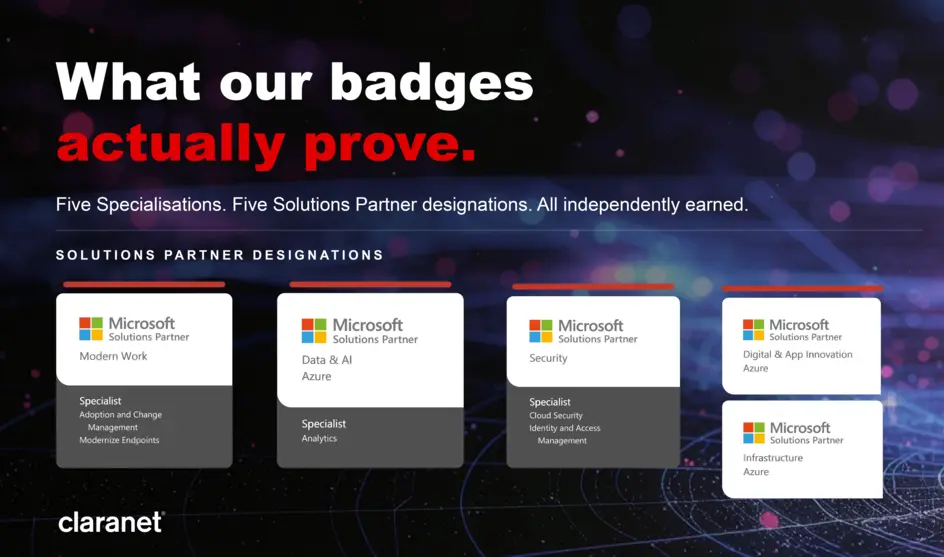
Microsoft recognises partners in two tiers, and we hold both across Azure, Modern Work, and Security. Solutions Partner designations show breadth. Each one certifies that we can deliver across an entire Microsoft cloud area. We hold five of the six:
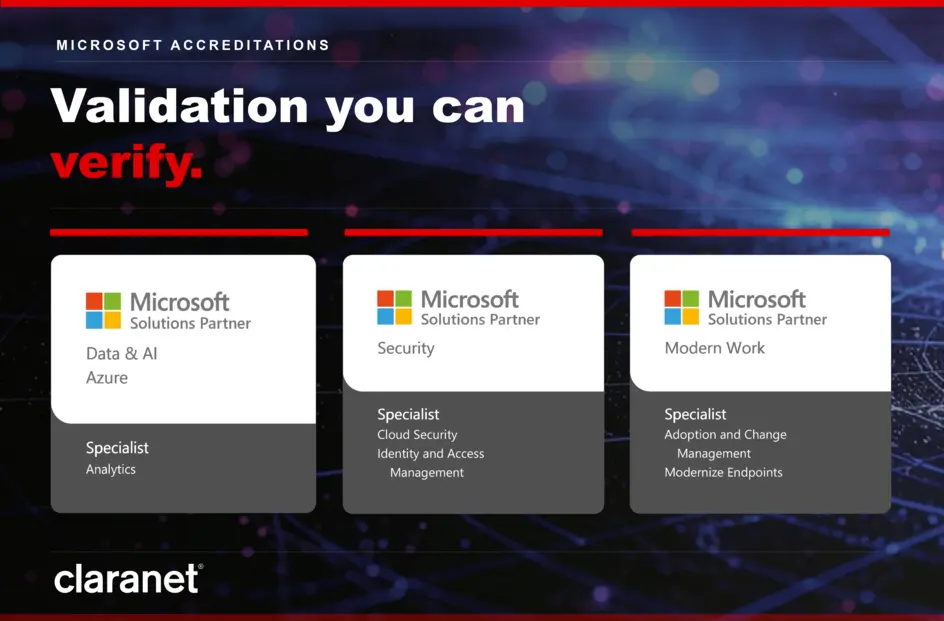
Specialisations show depth. Each one sits on top of a designation and validates that, within that area, we've been independently assessed on the hardest, most specific work. We hold five:
In short: the designations say we can deliver across the estate. The Specialisations say we've proven it, in depth, where it counts
What we had to prove to earn them?
This is the part that separates a real accreditation from a marketing badge. Microsoft doesn't hand these out. Every requirement is verified by Microsoft or an independent third-party vendor, and every badge has to be re-earned to keep it.
The designation bar
To hold a Solutions Partner designation, we have to reach a Partner Capability Score of at least 70 out of 100 in that area. That score isn't a single test. Microsoft calculates it across three categories:
- Performance ‒ real, measurable growth in the Microsoft technology our customers actually use.
- Skilling ‒ the number of engineers on our team holding current Microsoft certifications.
- Customer success ‒ successful, live deployments and sustained usage, not pilots.
We clear that bar in five areas, and we have to keep clearing it every year.
The specialisation bar
A Specialisation goes further. Before we can even apply, we need the matching designation. Then we have to meet performance and skilling thresholds and pass an independent check either a third-party audit (for Azure Specialisations) or a set of approved customer references (for Modern Work and Security). Here's what that meant in practice for each of ours.
| Specialisation | Built on | What we had to field | How it's independently checked |
|---|---|---|---|
| Analytics on Microsoft Azure | Data & AI (Azure) designation | A team of engineers certified as Fabric Data Engineers, plus sustained Azure analytics consumption across real customer workloads (Synapse, Data Factory, Data Lake, Fabric, Databricks). | Third-party audit of how we actually design and deliver. |
| Adoption and Change Management | Modern Work designation | Accredited adoption specialists, proven Microsoft 365 usage growth across multiple customer tenants, and measurable behavioural change. | Three approved customer references. |
| Modernise Endpoints | Modern Work designation | At least four engineers certified as Endpoint Administrator and Administrator Expert, at least two in Azure Virtual Desktop, plus real Microsoft Intune usage growth. | Three approved customer references. |
| Cloud Security | Security designation | At least six engineers passing the AZ-500 exam and four passing SC-200, plus sustained security-workload consumption. | Approved customer references, moving to an independent third-party audit. |
| Identity and Access Management | Security designation | At least six engineers certified as Identity and Access Administrators, plus proven Microsoft Entra ID usage growth. | Three approved customer references. |
The common thread: certified people, real customer deployments, and an outside check. Microsoft revises these thresholds regularly and keeps raising the bar, so holding a Specialisation isn't a one-off ‒ it's a standard we maintain.
How they help you?
Accreditations only matter if they change your outcome. Here's what ours change for you.
- You're not taking our word for it. Microsoft, or an independent auditor, has already verified the capability. That's assurance you can put straight in front of your own board.
- You're buying demonstrated delivery, not a logo. Behind each badge sits a fixed number of certified engineers, live customer deployments, and an external check. You're engaging a team that has already proven the exact work you need done.
- One accredited partner across your estate. Azure, Modern Work, Security, Data & AI, and identity all sit under one roof, so you get joined-up delivery instead of stitching together specialists who don't talk to each other.
- Current skills, not a certificate gathering dust. Because these have to be re-earned against changing requirements, the expertise behind them stays aligned with Microsoft's roadmap rather than ageing quietly.
- Access to Microsoft investment and engineering. Our accreditations can unlock Microsoft funding and co-sell support ‒ for example, investment towards assessments and migrations, and direct engineering escalation ‒ value we bring to the table on your project. You can check this case study to see how our Microsoft co-sell relationship helped accelerate Kier Group's move to Azure VMware Solution.
Frequently asked questions
- What's the difference between a Microsoft Specialisation and a Solutions Partner designation?
A Solutions Partner designation certifies broad capability across a whole Microsoft cloud area, earned through a Partner Capability Score of at least 70 out of 100. A Specialisation sits on top of a designation and validates deep, audited expertise in one specific area.
- Are these independently verified?
Yes. Every requirement is checked by Microsoft or an independent third-party vendor, through certified exams, live customer references, and ‒ for Azure Specialisations ‒ a third-party audit.
- How often are they renewed?
Continually. Both designations and Specialisations have to be re-earned against Microsoft's current thresholds, which change regularly, so an active badge reflects current capability.
Where to go next?
If you're planning work on Azure, rolling out Modern Work, or tightening up security and identity, our Microsoft accreditations are a shortcut to confidence: the hard questions about capability are already answered, in writing, by Microsoft.